


Table of Contents
- Understanding Business Data Needs
- Types of Data Storage Devices
- Key Factors in Selecting Data Storage
- Security and Compliance Considerations
- Scalability and Future-Proofing
- Cost Analysis and Budgeting
- Best Practices for Implementation
- Conclusion
In today’s digital era, selecting the right data storage devices is crucial for businesses looking to safeguard their data and support operational efficiency. As companies handle increasing amounts of data, understanding the features and benefits of various storage options is vital for long-term success. Get started with an in-depth exploration of your business’s options, with an understanding of DWPD, a helpful guide to the essential aspects of data storage reliability.
Taking a proactive approach not only protects sensitive information but also sets the stage for flexibility, security, and compliance. From traditional hard disk drives to cloud-based solutions, companies need to match their data needs with available technologies to avoid downtime, data loss, or costly expansions. Making an informed choice can enhance operational speed and ensure regulatory obligations are met at all times.
Understanding Business Data Needs
Every business generates, accesses, and manages data in unique ways. Determining your organization’s daily data volume, speed requirements, and the value placed on specific types of data is essential before investing in new technology. For example, design agencies that require quick access to large media files will have very different needs than law firms archiving confidential case records for years.
Businesses should also evaluate how downtime or data loss could impact daily operations or customer trust. Having a realistic picture of operational needs enables decision makers to choose solutions that are both functional and future-proof.
Types of Data Storage Devices
A growing range of storage devices is available to meet an organization’s requirements for performance, capacity, and accessibility:
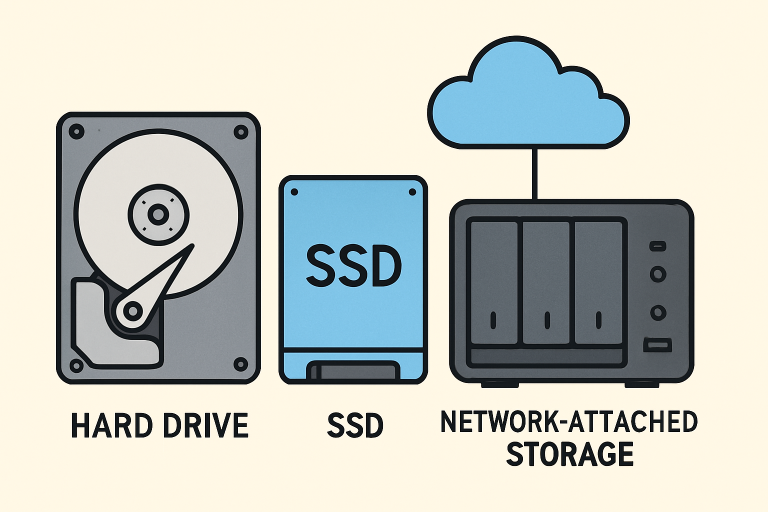
- Hard Disk Drives (HDDs): These are tried-and-true storage devices. They offer large capacities at a reasonable price point and are ideal for archival storage or non-critical data where speed is less of a concern.
- Solid-State Drives (SSDs): With no moving parts, SSDs offer fast data access and a lower risk of physical failure. They are perfect for running databases, virtual machines, and other workloads that demand rapid input and output.
- Network-Attached Storage (NAS): A NAS setup allows multiple users or devices on the same network to access and share files, streamlining collaboration and backup routines.
- Cloud Storage: By moving data off-site, the cloud provides almost limitless scalability and remote accessibility. This is a suitable option for companies with distributed teams or variable data needs.
Considering trade-offs among cost, speed, and durability helps companies make better long-term investments that align with their tech strategy.
Key Factors in Selecting Data Storage
- Performance: The speed at which storage devices read and write data directly impacts productivity. For businesses running real-time analytics or transaction processing, opting for high-speed SSDs can make a noticeable difference.
- Reliability: Data loss from hardware failure or unexpected downtime can cripple operations. Look for storage solutions with low failure rates, robust warranties, and the ability to implement RAID (redundant array of independent disks) for additional redundancy.
- Compatibility: Not all storage devices seamlessly connect with every system. Ensure your choice integrates seamlessly with existing infrastructure to minimize disruption and additional costs.
Involving IT specialists during this stage is crucial to prevent compatibility headaches and ensure alignment with the overall technology roadmap.
Security and Compliance Considerations
Protecting data from unauthorized access and meeting industry regulations is vital, especially for organizations in healthcare, finance, or e-commerce. Encrypting sensitive data, establishing stringent access controls, and regularly auditing usage are foundational for safeguarding company and customer data.
For instance, businesses dealing with healthcare records must comply with HIPAA, while retailers processing card payments must adhere to PCI DSS. Failing to comply can result in hefty fines and irreparable damage to your reputation.
Scalability and Future-Proofing
The right storage solution should evolve with your business. Cloud storage services and modular NAS units enable you to rapidly expand capacity as data volumes grow. Avoiding rigid solutions means your organization can quickly adapt to emerging needs or regulatory changes without extensive downtime or disruption.
Future-proofing also involves regularly evaluating storage trends and adopting technologies that offer extended support and backward compatibility, ensuring investments made today continue to deliver value tomorrow.
Cost Analysis and Budgeting
The cost of data storage extends beyond hardware purchases. Cloud environments often feature a pay-as-you-go model, but recurring fees can add up over time. Local, on-premises devices usually require a greater upfront investment but can be more cost-effective in the long term, especially for predictable workloads.
It is important to calculate both direct (hardware and software) and indirect (maintenance, upgrades, and energy consumption) costs. Comparing the long-term total cost of ownership can help businesses select solutions that remain sustainable as needs evolve.
Best Practices for Implementation
- Data Backup: Regular, automated backups ensure data can be recovered in the event of a breach or malfunction.
- Access Controls: Assign permissions based on role or need to restrict sensitive data and minimize exposure to insider threats.
- Regular Maintenance: Schedule checks and software updates frequently to maintain optimal performance and reduce the risk of vulnerabilities.
Following best practices from trusted sources can help streamline rollouts and safeguard against human error or compliance lapses.
Conclusion
The process of choosing the right data storage devices should be approached strategically, with attention to a company’s current requirements and long-term objectives. Evaluating factors from performance and reliability to compliance and total cost ensures an optimal fit for your business. With the right storage foundation, companies can protect their data, empower their teams, and support continued growth in an increasingly data-driven world.
